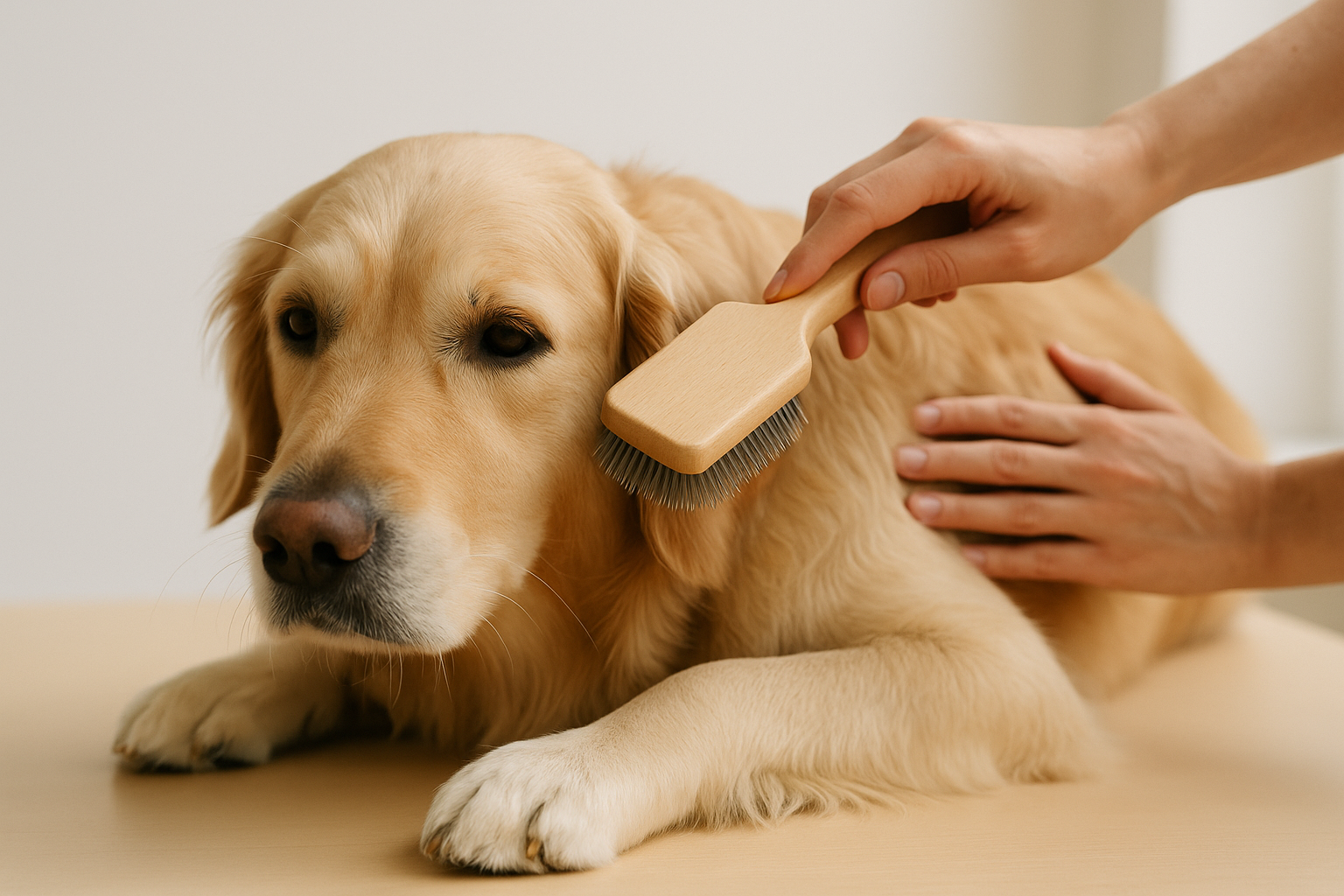
Most dog owners know they should be grooming their dogs at home, but not many have a clear idea of what that actually involves. The answer changes quite a bit depending on coat type. A weekly brush is enough for some dogs; for others, it's a daily requirement. This guide goes through each part of the home grooming routine and tells you how often each actually needs to happen — based on coat, not on generic advice.
Coat types and what they need
Before anything else, it helps to know which of the six main coat types your dog has. The same routine doesn't work across all of them.
Smooth coats
Breeds like Beagles, Boxers, and Dalmatians have short, close-lying coats. They shed regularly but don't tangle. A rubber grooming mitt once a week removes loose hair and keeps the coat looking clean. Bathing every 4 to 6 weeks is usually enough unless the dog has been rolling in something. Nail trims every 3 to 4 weeks.
Double coats
This group includes Huskies, Golden Retrievers, Border Collies, and similar breeds. The outer coat is coarser; the undercoat is dense and soft. Shedding is significant — especially in spring and autumn. Weekly brushing with a slicker brush and a metal undercoat rake keeps matting under control. During shedding season, daily brushing is realistic if you want to stay ahead of the hair. Bathing every 6 to 8 weeks. Do not shave double-coated breeds — the undercoat regulates temperature in both directions.
Long, silky coats
Yorkies, Afghan Hounds, Maltese, and Shih Tzus fall here. The coat grows continuously and tangles easily around the ears, legs, and under the arms. Daily brushing is the realistic minimum. A de-tangling spray makes this easier. Most owners either learn to maintain the full coat or keep these dogs in a shorter trim — both are reasonable. Bathing every 2 to 3 weeks.
Curly and wavy coats
Poodles, Lagotto Romagnolos, and mixed-breed doodles. The coat doesn't shed much but it mats quickly, especially around the neck and ears. Brushing 3 to 4 times per week, working in sections with a slicker brush. These coats generally need a professional trim every 6 to 8 weeks — the home routine is maintenance between grooms, not a replacement for them.
Wire coats
Terriers, Schnauzers, and similar breeds. The coat has a rough outer texture. Brushing 2 to 3 times per week. Hand-stripping maintains the correct texture for show dogs; most pet owners use a clipper or scissor trim instead. Bathing every 4 to 6 weeks.
Hairless breeds
Chinese Crested, Xoloitzcuintli. No brushing needed, but the skin needs attention. Weekly wipe-down, monthly bath, and sun protection if the dog spends time outside.
Brushing: the practical version
Work in sections rather than over the whole coat at once. Start at the back legs and work forward. This way you don't push tangles further into the coat as you brush. On long-coated dogs, hold the coat above the section you're working on to avoid pulling from the root.
A slicker brush (the rectangular brush with fine metal pins) handles most coat types. A metal comb with both wide and narrow teeth is useful for checking that you've worked through to the skin — if the comb moves through easily, you have. If it catches, there's still work to do.
Never brush a wet coat unless you're using a de-tangling spray. Wet hair stretches before it breaks, so you can cause damage that isn't immediately obvious.
Bathing
Use a dog-specific shampoo. Human shampoo is formulated for a different pH level and can irritate skin over time. The frequency depends on coat type as listed above — but the single most common mistake is bathing too often, which strips natural oils and causes dry skin and increased shedding.
Rinse more thoroughly than you think is necessary. Shampoo residue left in the coat causes irritation and dull appearance. A second rinse after you think you're done is not excessive.
Blow-dry completely if possible, especially on double-coated and long-coated breeds. Leaving the undercoat damp encourages matting and, in some cases, a condition called hot spots.
Nail trimming
The nail should not touch the ground when the dog is standing. If you hear clicking on hard floors, they're overdue. Every 3 to 4 weeks is usually the right frequency for dogs that don't wear their nails down on pavement.
Use a sharp nail clipper — guillotine-style or scissor-style both work. Cut small amounts at a time to avoid the quick (the blood vessel inside the nail). On white nails, you can see the quick as a pinkish area. On dark nails, cut in thin slices until the cut surface shows a small grey or pink dot in the centre — that's the edge of the quick, stop there.
If you cut the quick, apply cornstarch or styptic powder. It bleeds a lot for a small injury. Stay calm so your dog stays calm.
Ear care
Check ears weekly. A healthy ear is pale pink with no odour and no visible debris. Use a cotton ball dampened with dog ear cleaner to wipe the visible inner ear — don't push anything into the ear canal.
Dogs with floppy ears (Spaniels, Basset Hounds) and dogs with hair in the ear canal (Poodles, Schnauzers) are more prone to ear infections. If you notice redness, discharge, or if the dog is scratching or shaking its head more than usual — that's a vet visit, not a grooming issue.
When home grooming isn't enough
There are specific situations where home grooming becomes inadequate or counterproductive:
- Matting that can't be brushed out without causing pain — at this point, clipping out is the better option and requires professional tools
- Dogs who become aggressive or extremely distressed during grooming — a professional environment and technique can manage this better than a home setting
- Curly and wavy coats that need a trim — maintaining coat length and shape requires proper scissors and knowledge of the breed standard or owner preference
- Anal gland expression, if needed — this is not a home grooming task
The service quiz takes 7 questions and gives a direct answer about whether professional grooming makes sense for your dog's current situation.